Requirements
US Visa and Immigration Photos by Form: 2026 Guide
Which US visa and immigration forms need your photo in 2026: DS-160 uploads, DS-260 prints, DV entries, USCIS forms and biometrics, in one sourced table.
By Antoine Duno
Updated September 18, 202613 min read
Specs verified on September 16, 2026 against the issuing authority
Say "US immigration photo" and people picture one thing: a 2 x 2 inch print. In 2026 there are at least four different things, depending on the form. Some forms want a square digital file you upload yourself. Some want two identical prints handed over at an interview. Some want prints in the mail. And for the USCIS forms that produce a green card or a naturalization certificate, the photo on the finished document is now one USCIS takes itself, at your biometrics appointment.
This page sorts the forms by who takes the photo, so you know whether you need a file, prints, or nothing at all.
- DS-160 / DS-1648
- Upload: square JPEG, 600-1200 px, 240 kB max
- DS-260 immigrant visa
- 2 identical 2 x 2 in prints at interview
- DV lottery entry
- Upload: 600 x 600 JPEG, 240 kB max, per person
- DV selectee interview
- 2 identical 2 x 2 in prints
- I-485, N-400, N-600, I-90
- New photo taken at biometrics, no reuse
- I-485, I-765 instructions
- Still list 2 passport-style photos
- N-400, N-600 from the US
- No photos with the form
- Other USCIS benefits
- Biometrics photo reused if 36 months old or less
- ESTA
- Passport bio page photo; selfie proposed
All of it is on the US visas and immigration topic hub, one guide per form. This page is the map.
The three ways a photo reaches the US government
Before the form-by-form detail, it helps to see that every route falls into one of three patterns.
1. You make a digital file and upload it. The Department of State's online forms work this way: the DS-160 nonimmigrant visa application and the Diversity Visa entry. The file is checked by software as you upload, and a consular officer looks at it later. You are responsible for the pixels.
2. You supply printed photos. Immigrant visa applicants bring two identical prints to the interview. Several USCIS form instructions ask for two prints in the envelope. You are responsible for the print, the paper and the size in inches.
3. The government takes the photo. At a USCIS biometric services appointment, your photo is captured on site. At CBP's ESTA mobile app, your face is matched live against your passport chip. Nothing you bring from home ends up on the document.
The confusion comes from forms that sit in two patterns at once, and USCIS is where that happens most.
State Department forms: visas and the DV lottery
DS-160 nonimmigrant visa: a file, and sometimes a print
If you apply for a nonimmigrant visa on the DS-160 or DS-1648, the form instructs you to upload a digital image. The State Department's digital image requirements set the file rules:
| Requirement | DS-160 digital image |
|---|---|
| Shape | Square, height equal to width |
| Dimensions | 600 x 600 minimum, 1200 x 1200 maximum |
| Format | JPEG |
| File size | 240 kB or less |
| Colour | 24 bits per pixel, sRGB |
| Compression | 20:1 or less |
| Head height | 50% to 69% of the image height |
The visa photo page adds that some embassies and consulates require applicants to bring one photo meeting the requirements to the interview. And if your confirmation page shows an "X" instead of your photo, the upload failed, and the photo FAQ says to take one printed photo with the confirmation page to the embassy or consulate.
Our DS-160 photo requirements guide covers every line of that specification, and the DS-160 upload error guide covers what to do when the form refuses a file.
DS-260 immigrant visa: two prints at the interview
The DS-260 is completed online, but the photos are not uploaded with it. The State Department's photo FAQ is explicit: if you apply for an immigrant visa using Form DS-260, you must provide two identical photos at your immigrant visa interview, printed on photo quality paper, 2 x 2 inches (51 x 51 mm). The paper may be matte or glossy.
The appearance rules are the ones every US visa photo follows: taken within the last six months, plain white or off-white background, full face, neutral expression, both eyes open, head between 1 inch and 1 3/8 inches from chin to top of head. Eyeglasses have not been allowed in new visa photos since November 1, 2016, apart from rare medical cases with a signed statement. The full breakdown, including what your embassy may add, is in our DS-260 photo requirements guide.
The DV lottery entry: one file per person
The Diversity Visa entry form is the strictest upload in this list, because a photo problem can make you ineligible rather than just delaying you. The DV-2026 instructions, the most recent full set published, ask for:
- A JPEG, 600 x 600 pixels, square, 240 kB or less
- Taken within the last six months
- A separate photo for you, your spouse and every derivative child on the entry
- No eyeglasses
- Never the photo you submitted with a prior year's entry, which the instructions say will make you ineligible
If you are selected, the photos come up again: DV selectees bring two identical 2 x 2 inch prints to the interview, like any other immigrant visa applicant.
Start with our DV lottery photo requirements guide, then DV lottery family photos for who has to be on the entry.
US passports, for comparison
A US passport is not an immigration document, but people applying for both mix up the specs. A paper passport application takes one printed 2 x 2 inch photo, head 1 to 1 3/8 inches (25 to 35 mm) from chin to top of head. The visa pages above ask for two prints at an immigrant visa interview. Our US passport photo requirements guide has the passport rules in full.
USCIS forms: what changed on December 12, 2025
This is the part most guides get wrong, in both directions. Some still sell "I-485 photo packages" as if nothing changed. Others say USCIS no longer wants photos at all. The primary sources say something more awkward than either.
What the policy says
On December 12, 2025, USCIS published Policy Alert PA-2025-29, "Photograph Reuse for Identity Documents", and announced it in a newsroom alert. Three things changed:
- Self-submitted photos are out for secure documents. The policy alert says USCIS "will not use or reuse self-submitted photographs." The newsroom alert puts it more bluntly: self-submitted photos "will no longer be accepted", and only photos taken by USCIS or other authorized entities will be used.
- Four forms always need a new photo. The Policy Manual says photo reuse is not permitted for the N-400 (naturalization), N-600 (certificate of citizenship), I-90 (replace a permanent resident card) and I-485 (adjustment of status). These forms require the collection of new biometrics, including a new photograph.
- Everything else has a 36-month limit. For other benefit requests, USCIS may reuse a photo collected at a biometric services appointment only if no more than 36 months (3 years) have passed since it was taken, at the time of filing.
The alert explains why. During COVID-19, USCIS reused photos to keep people away from Application Support Centers, and a photo on a secure document could end up as much as 22 years old by the time that document expired.
What the form instructions still say
Here is the inconvenient part. On September 16, 2026, the instructions posted on uscis.gov still told applicants to mail photos for several forms:
| Form | What the current instructions say about photos |
|---|---|
| I-485 (edition 09/04/26) | "You must submit two identical color passport-style photographs of yourself taken recently" |
| I-765 (edition 08/21/25) | Two identical colour passport-style photographs |
| I-131 (edition 01/20/25) | Two identical colour passport-style photographs for a Refugee Travel Document filed from outside the US, an Advance Parole Document or a TPS Travel Authorization Document |
| N-400 (edition 01/20/25) | Two photos only if you are applying from outside the United States in one of the eligible categories |
| N-600 | "You no longer need to submit photographs" unless you reside outside the United States |
| I-90 (edition 01/20/25) | No photo requirement in the instructions |
The I-485 instructions are the telling case: that edition is dated after the policy alert and still lists two photos. The USCIS evidence checklists for the I-485 and I-765 say the same.
So the honest summary is this. For the four forms named in the Policy Manual, the photo on your green card or certificate will be taken at biometrics, whatever you mail. For the I-485 and I-765, the instructions still list prints as part of the filing. USCIS has not published anything we could find that reconciles the two, and we are not going to guess how a mailroom treats a package without them. Follow the instructions for the form edition you are filing, and read green card photo requirements for the I-485 detail.
The USCIS print specification
Where a USCIS form does ask for prints, the instructions use the same paragraph across the I-485, I-765, I-131, N-400 and N-600:
| Requirement | USCIS passport-style photos |
|---|---|
| Number | Two identical |
| Colour | Colour |
| Size | 2 by 2 inches |
| Head height | 1 to 1 3/8 inches, top of hair to bottom of chin |
| Eye height | 1 1/8 to 1 3/8 inches from the bottom of the photo |
| Background | White to off-white |
| Paper | Thin paper with a glossy finish |
| Condition | Unmounted and unretouched |
| Head | Bare, unless headwear is required by your religious denomination |
| On the back | Your name and A-Number, if any, lightly in pencil or felt pen |
Two details differ from the State Department's visa prints. USCIS says glossy, where the visa FAQ accepts matte or glossy. And USCIS asks you to write on the back. The I-131 instructions add a technical note: because of the USCIS scanning process, a digital photo must come from a camera with at least 3.5 megapixels.
The I-765 page carries an alert on retouching: unretouched means not edited or digitally enhanced, and submitting mounted or retouched photos will delay processing and may prompt USCIS to require you to appear at an Application Support Center to verify your identity. Our guides to the I-765 work permit photo and I-131 travel document photos go form by form.
ESTA: no photo file, and a selfie on the way
ESTA sits outside all three patterns. It is a travel authorization for Visa Waiver Program travellers, and the application uses a photo of your passport's biographical page rather than a portrait you shoot.
In a Federal Register notice published on December 10, 2025, CBP said it intends to update the ESTA website to require applicants to provide a photograph of their face, a "selfie", in addition to the passport page photo, and to require third-party submissions to include one too. The same notice describes the ESTA mobile app matching the passport chip portrait against a live selfie. A live selfie is not something a prepared file can stand in for. Our ESTA photo guide tracks where that proposal stands.
Work out which photo you need
- 1
Name the form, not the goal
"Green card" can mean a DS-260 abroad or an I-485 in the United States, and they have completely different photo routes. Write down the form number you are filing.
- 2
Check the edition of the instructions
USCIS changes form editions. Open the instructions for the edition you are filing and search for "photograph". What that text says is what goes in the envelope.
- 3
Separate file from print
DS-160 and DV entries want a JPEG. DS-260, DV selectee interviews and USCIS forms that ask for photos want 2 x 2 inch prints. The same shot can produce both, but not the same file.
- 4
Expect a biometrics photo anyway
For the I-485, N-400, N-600 and I-90, plan to be photographed at a biometric services appointment, whatever else you send.
- 5
Take the photo last
Visa photos must be taken within six months. Shoot once your filing date is known, not when you start gathering documents.
The face rules every route shares
The formats differ, but what a reviewer checks in the face is close to identical across the State Department and USCIS:
- Taken recently: within six months for State Department photos
- Plain white or off-white background
- Full face, directly facing the camera, both eyes open
- Neutral expression for visa photos
- Head bare, unless covering is worn for religious reasons
- Eyeglasses in a visa photo, outside rare medical cases
- Headphones or wireless hands-free devices
- Retouching, filters or a replaced background
- A photo copied or scanned from a licence or other official document
- A photo reused from a previous DV entry
The retouching rule deserves its own warning. The State Department says visa photos must not be digitally enhanced or altered to change your appearance in any way, and USCIS asks for unretouched prints. Cropping and resizing are fine. Replacing a background is not. Our guide to AI-edited passport photos explains where that line sits.
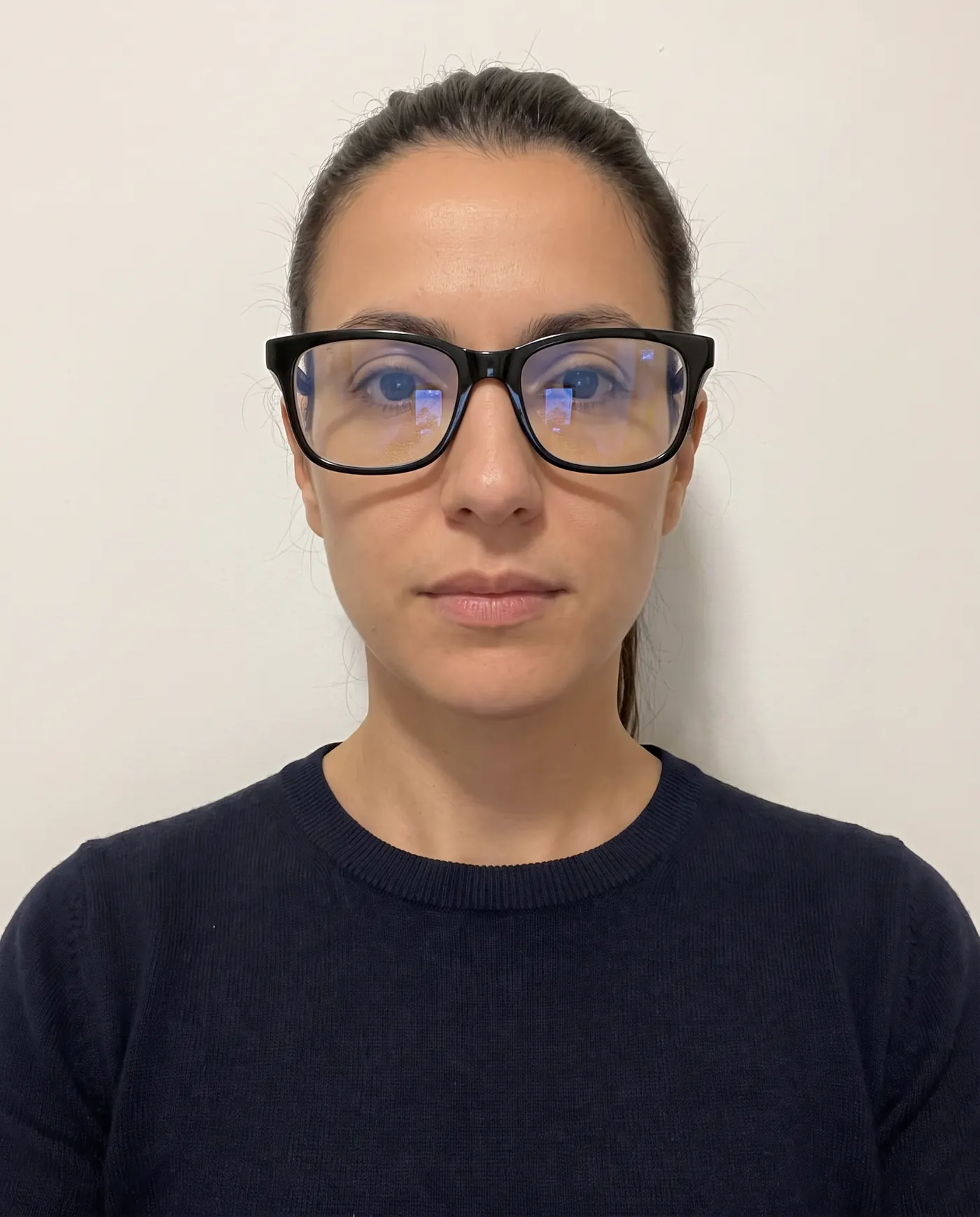 Rejected
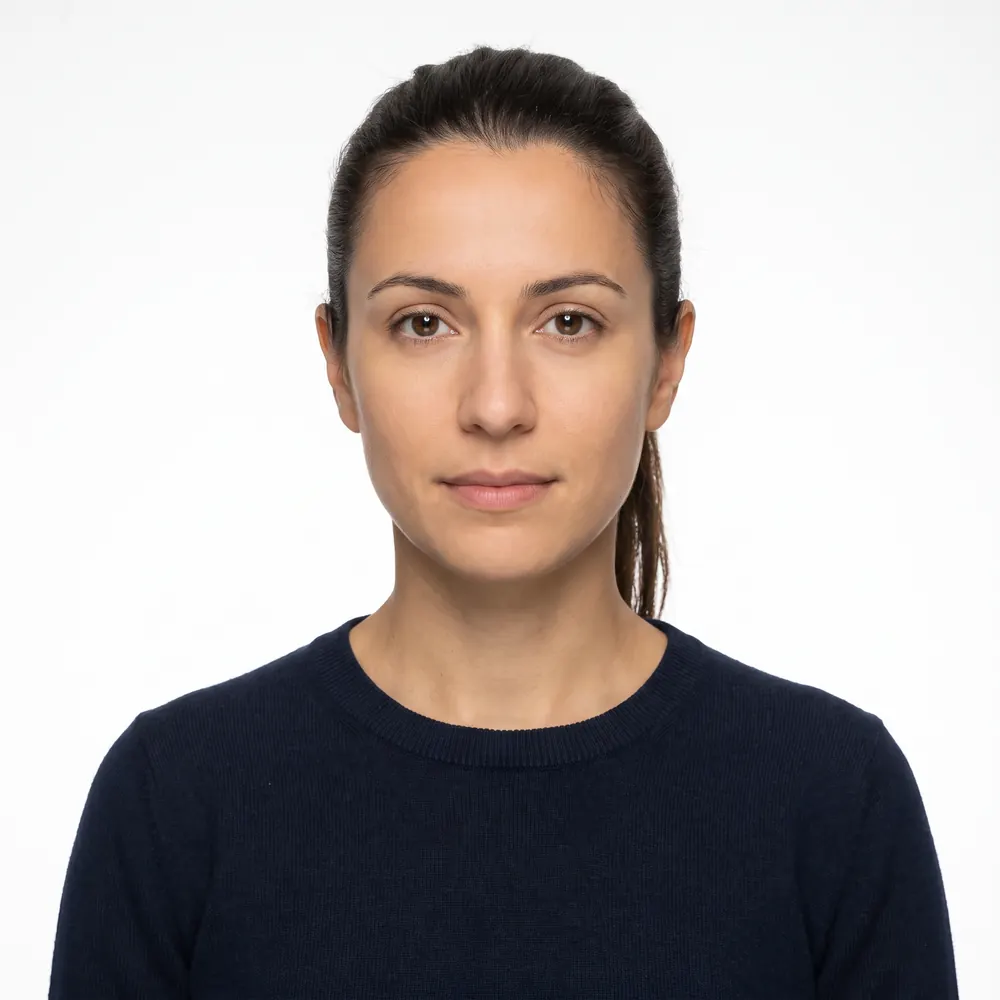 Accepted
Children and babies: no separate standard
Families filing several applications at once often assume a baby gets an easier photo. For State Department visa photos, the written rules give very little.
The visa photo FAQ answers two questions parents ask directly. Can a parent or guardian appear in the child's photo? No: the child must be the only person in the photo, and nothing used to support the child should be in the frame, including a parent's arms or hands. Is it acceptable for the child's eyes to be closed? No: the child's eyes should be open and looking straight ahead at the camera.
What the State Department does offer is two practical setups: lay the baby on their back on a plain white or off-white sheet, or cover a car seat with one and photograph the child in the seat. In both cases, watch for shadows on the face, especially when shooting from above.
That applies to a child's DS-160 file, a child's DV entry photo, and the prints for a child's immigrant visa interview. A DV entry needs a photo of every derivative child, newborns included, which is why we wrote a separate DV lottery baby photo guide.
For a child's USCIS filing, the instructions quoted above use the same print paragraph for every applicant and set no separate standard for children. If your family is in the United States and filing for a baby, our baby passport photo guide covers the home setup in more detail.
Where our tool fits, honestly
We are an independent photo service with no connection to the Department of State, USCIS or CBP.
For the DS-160 and the DV entry, we do the whole job: crop a phone photo square, check the head sits inside the 50-69% window, and export a JPEG under 240 kB. For the DS-260 interview and USCIS forms that still ask for 2 x 2 inch prints, we produce a print sheet you take to any photo counter; for USCIS, ask for glossy paper. You check for free and pay only at download, with no subscription.
What we cannot do is replace a photo the government takes itself. If your form is an I-485, N-400, N-600 or I-90, the photo on your card or certificate comes from your biometrics appointment. If you are applying for ESTA through the mobile app, the selfie has to be live. When a prepared photo is actually what your form asks for, start with one phone photo against a white wall.
Frequently asked questions
Does USCIS still accept photos I send with my application?
USCIS says it will not use or reuse self-submitted photographs for its secure documents. Its December 12, 2025 policy alert makes the photo taken at a biometric services appointment the one that counts. The form instructions for I-485, I-765 and some I-131 documents still list two passport-style photos, so read the current instructions for your form.
Which forms need a new photo taken at biometrics?
The USCIS Policy Manual names four: Form I-485, Form N-400, Form N-600 and Form I-90. For those, USCIS does not reuse an earlier photo and you attend a biometric services appointment for a new one. For other benefit types, it may reuse a photo it collected within the previous 36 months.
How many photos do I need for an immigrant visa interview?
Two identical photos. The State Department's photo FAQ says applicants using Form DS-260, and Diversity Visa selectees, must provide two identical photos at the immigrant visa interview, printed on photo quality paper and 2 x 2 inches (51 x 51 mm).
Is a DS-160 photo the same as a USCIS passport-style photo?
No. The DS-160 takes a square JPEG between 600 x 600 and 1200 x 1200 pixels, 240 kB or less. USCIS instructions ask for 2 x 2 inch prints on thin glossy paper, with your name and A-Number lightly written on the back. The face rules overlap, the formats do not.
Does the DV lottery entry need a photo of every family member?
Yes. The DV instructions ask for recent photos of you, your spouse and every derivative child on the entry, each a 600 x 600 JPEG of 240 kB or less. A spouse or child who is already a U.S. citizen or permanent resident does not need one.
Do I need a photo for ESTA?
An ESTA application uses a photo of your passport's biographical page. In a December 2025 Federal Register notice, CBP said it intends to also require a selfie on the ESTA website and for third-party submissions. Check esta.cbp.dhs.gov for what the application asks for on the day you apply.
Sources
- USCIS - Policy Alert PA-2025-29, Photograph Reuse for Identity Documents (December 12, 2025)
- USCIS Newsroom - New Photo Policy Helps Prevent Immigration Fraud Through Enhanced Identity Verification
- USCIS Policy Manual - Volume 1, Part C, Chapter 2, Biometrics Collection (current as of September 14, 2026)
- USCIS - Form I-485 Instructions (edition 09/04/26)
- USCIS - Form I-765 Instructions (edition 08/21/25) and I-765 page alert on unretouched photos
- USCIS - Form I-131 Instructions (edition 01/20/25)
- USCIS - Form N-400 page and instructions
- USCIS - Form N-600 page (photographs)
- USCIS - Form I-90 Instructions (edition 01/20/25)
- U.S. Department of State - Visa Photo Requirements (travel.state.gov content, read on the adoption.state.gov mirror)
- U.S. Department of State - Digital Image Requirements
- U.S. Department of State - Photo Frequently Asked Questions
- U.S. Embassy in Cameroon - Instructions for the 2026 Diversity Immigrant Visa Program (DV-2026)
- U.S. Embassy in Hungary - Changes to Entry Period for the 2027 Diversity Visa Program
- U.S. Mission Poland - Passport Photo Requirements
- Federal Register / GovInfo - CBP information collection: Form I-94 and ESTA (December 10, 2025)
Keep reading
DS-160 Photo Requirements 2026: Exact Specs
Every DS-160 photo spec with its source: 600x600 to 1200x1200 pixels, 240 kB JPEG, head at 50-69% of image height, no glasses. Checked 16 September 2026.
Read the guideRequirementsDV Lottery Photo Rules: Don't Get Disqualified
DV lottery photo rules: a 600x600 JPEG under 240 kB, a separate photo per family member, and the reuse rule that makes an entry ineligible.
Read the guideRequirementsUS Passport Photo Requirements (2026): Complete Checklist
Every US passport photo rule in one checklist: 2x2 inch size, head height, white background, expression, glasses, head coverings and online renewal.
Read the guideRequirementsDV Lottery Family Photos: Who Must Be on the Entry
DV lottery family photos: a separate photo for you, your spouse and every unmarried child under 21, who is exempt, and the omissions that void an entry.
Read the guideTroubleshootingDS-160 Photo Upload Error? Fix It in 2 Minutes
Every DS-160 photo upload error explained: what the CEAC check rejects, the exact file specs, and how to make a photo that passes. Pay only at download.
Read the guideRequirementsPassport Photo Sizes by Country: 2026 Table
Passport photo size by country in mm, inches and pixels, with head heights and backgrounds. Ten authorities, every figure checked on the official page.
Read the guide