How-to
Baby Passport Photo at Home: US Rules for Newborns
US passport photo rules for babies, quoted from the State Department: eyes can be partly closed, no hands in frame, white-sheet and car-seat setups.
By Antoine Duno
Updated September 25, 202611 min read
Specs verified on September 16, 2026 against the issuing authority
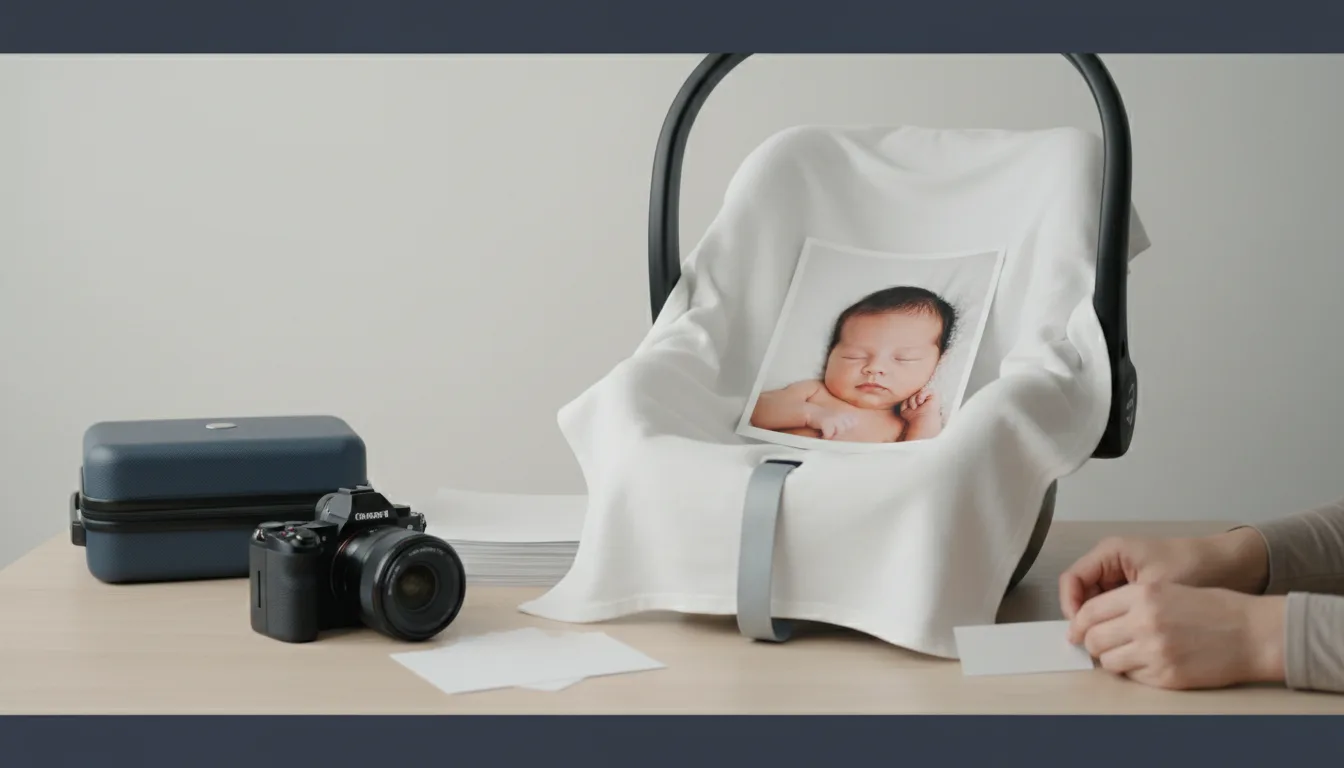
A passport photo at a store counter asks a newborn to cooperate on someone else's schedule, under someone else's lights. At home you control the timing, the light and the number of attempts, and the State Department's rules for babies are written around exactly the setups a home allows: a white sheet on a bed, or a car seat draped in one.
The US rules also give babies one real concession that adult photos, and US visa photos, don't get.
The rules below are quoted from the State Department's Passport Photos page (last updated March 24, 2026) and its Apply for a Child's Passport Under 16 page, read on the Department's adoption.state.gov mirror because travel.state.gov blocks automated readers. The UK comparison comes from GOV.UK.
- Print size
- 2 x 2 in (51 x 51 mm)
- Head height
- 1 to 1 3/8 in (25-35 mm)
- Photos with a DS-11
- 1, not stapled to the form
- Maximum age
- Taken in the last 6 months
- Eyes
- Baby's may be not entirely open
- Expression
- Neutral
- Other people
- None in the photo
- Background
- Plain white or off-white sheet
- Suggested setups
- Lying on a sheet, or sheet-covered car seat
- Edits
- None: no software, filters or AI
What the State Department actually says about babies
The Passport Photos page has a short section headed "Babies and toddlers." Here it is in full, because every word of it matters when you're setting up:
- "For background, place your child on a plain white or off-white sheet. You can also cover a car seat with the sheet, then place your child in the car seat for the photo."
- "Make sure there are no shadows on your child's face."
- "No other person can be in the photo."
- "The child must face the camera."
- "The child's facial expression must be neutral."
- "The child's full face must be visible."
- "It is okay if a baby's eyes are not entirely open. All other children must have their eyes open."
The example photos show what it turns down: a child not facing forward, an exaggerated expression, a face blocked by hands, a blurry photo on a non-white background, a pacifier covering part of the face, and a photo with a busy background, another person in it and part of the child's face blocked. Its fix for that last one is the car seat with a white or off-white blanket.
Nothing else is relaxed. The size, head height, six-month rule, lighting rules and ban on digital changes in our US passport photo requirements guide all apply to a two-week-old exactly as they apply to you.
The eyes rule is a passport rule, not a visa rule
"It is okay if a baby's eyes are not entirely open" is the most useful sentence on the page, because newborns are drowsy much of the day. But it is written for US passports only.
The State Department's visa photo FAQ answers the same question the other way. Asked whether a child's eyes can be closed, it says: "No. Please have your child's eyes open and looking straight ahead towards the camera." So if you are photographing a baby who is not a US citizen, for a visa application or a Diversity Visa entry, the passport leniency does not apply. Our DV lottery baby photo guide and our guide to the DS-160 photo for a child cover those rules.
Aim for open eyes anyway, even for a passport. Open eyes meet the rule with no room for interpretation; "not entirely open" is a judgment the reviewer makes, not you.
How the UK compares
If your baby has a claim to a British passport too, or you're reading this from the UK, GOV.UK is more lenient in some places and stricter in others:
| Rule | US passport | UK passport |
|---|---|---|
| Eyes | Baby's may be not entirely open | Under one: need not be open |
| Looking at the camera | Child must face the camera | Under 6: need not look directly at the camera |
| Expression | Must be neutral | Under 6: need not be plain |
| Supporting hand | No other person in the photo | Under one: may support the head, hand not visible |
| Toys and dummies | Pacifier blocking the face is unacceptable | Babies must not hold toys or use dummies |
| Setup | White sheet, or sheet over a car seat | Under one: lie on a plain light-coloured sheet, photo taken from above (digital photo rules) |
| Photo age | Last 6 months | Last month |
The UK's print size is also different: 45 mm high by 35 mm wide. Our UK child passport photo guide covers the countersignature and the rest.
Why home is easier than a studio
This is not a knock on photographers. It's that the rules for babies reward time, and a studio appointment doesn't have much.
A newborn's alert, calm moments are short and don't arrive on schedule. At home you can wait for it, shoot a burst of frames, check them on the screen, and try again tomorrow if the day goes wrong. The white sheet the State Department suggests also doubles as a safe, flat surface, which a studio stool isn't for a baby who can't sit up.
The State Department lists "a friend or family member" as an acceptable source for passport photos, alongside acceptance facilities and photo businesses, so a parent with a phone is a legitimate photographer. Our pillar guide on how to take a passport photo at home covers the general setup for adults; the rest of this page is the baby version.
Setup 1: baby lying on a white sheet
Best for newborns who can't hold their head up.
- Pick the surface. A bed or a firm, safe surface on the floor, near a large window. Keep one hand ready to steady the baby between shots, out of frame when you press the shutter.
- Lay the sheet flat. Plain white or off-white, pulled tight. Creases throw lines of shadow that read as texture, and the rules ask for a plain background. Our guide to a white background for passport photos covers what counts as white enough.
- Place the baby on their back, head centered on the sheet, face turned straight up, with nothing near the face: no blanket edge, no burp cloth, no toy.
- Shoot from directly above, phone parallel to the baby's face. An angled phone makes the head look tilted.
The catch with this setup is your own shadow. When you lean over a baby, your head, arms and phone block the light. Put the window to one side of the baby's head rather than behind you, keep your body on the side away from the light, and hold the phone out rather than hunching over. Check the face on the screen: a darker band across the forehead or one cheek is your shadow.
Setup 2: car seat covered with a sheet
Best from a few weeks old, and the Department's own fix for a photo with a busy background and someone else in it.
- Drape the sheet over the car seat so it covers the back and head support completely. Tuck it so no straps, buckles, padding or seat edges show around the head.
- Buckle the baby in as usual, then check that no strap or buckle shows near the face.
- Set the seat facing a window, so light falls evenly on the face.
- Shoot straight on, phone at the baby's eye level, not from above. A slightly reclined seat still gives you a far more upright face than lying flat, which makes the "face the camera" rule easier.
Getting a usable frame
- 1
Plan for the alert window
Right after a feed or a nap, when the baby is fed, warm and calm. Have a second adult stand just behind the phone to make noise or hold a toy above the lens, out of frame.
- 2
Use daylight, not the flash
The State Department's red-eye advice is to adjust or turn off the flash, and says not to edit red eye out. Soft window light also avoids the harsh shadows a flash throws on a sheet.
- 3
Keep the phone steady
Blur is one of the Department's rejected child examples. Its tip: a shorter exposure, a tripod, or a steady surface. More light gives the phone a faster shutter.
- 4
Shoot a burst, at a sensible distance
Don't zoom in; move the phone. Fill most of the frame with head and shoulders, leaving margin to crop. Take dozens of frames; a baby's face changes every second.
- 5
Pick the frame, then check it at full size
Face toward the camera, head not tilted, neutral expression, no hand or pacifier, no shadow on the face, sheet plain. Eyes open is best; not entirely open is acceptable for a US passport.
- 6
Crop to 2 x 2 inches without changing anything else
Crop and resize the original file so the head measures 1 to 1 3/8 inches in a 2 x 2 inch print. Do not remove hands, smooth the sheet or brighten the face.
Head size: the rule parents miss
A baby's head is small, and parents naturally step back to fit the whole baby in. The size rule doesn't scale with the child: in the finished 2 x 2 inch print, the head still has to measure 1 to 1 3/8 inches (25 to 35 mm) from the bottom of the chin to the top of the head. The State Department's examples reject a photo taken "far away from the camera or it is too zoomed out," and one where the head is not centered and fully in the photo.
That is why the steps above say to fill most of the frame with head and shoulders. A crop from a full-body shot of a baby on a bed ends up with a tiny head, or a crop so tight it turns grainy, which is its own rejection.
Hair, if the baby has any, may extend past the edges of the photo, as long as the whole head is shown and sized correctly.
The checklist before you print
- Baby alone in the photo, facing the camera
- Plain white or off-white sheet, smooth, no shadows
- Neutral expression, full face visible
- Eyes open, or not entirely open for a US passport only
- Head 1 to 1 3/8 in in a 2 x 2 in color print, taken in the last 6 months
- A parent's hand, arm or lap visible anywhere in the frame
- A pacifier, toy, blanket or bib covering part of the face
- Car seat straps, padding or a patterned seat showing
- A shadow from you or the phone across the face
- A hand, shadow or crease edited out afterwards
Printing and applying
A baby's passport is applied for in person. The State Department says a child under 16 must apply on Form DS-11 at a passport acceptance facility, usually with both parents or guardians present, and that you cannot renew a child's passport: you apply in person each time, and the passport is valid for 5 years. Online renewal is not an option for a child.
For the photo, the child's application page says to provide one photo, and adds an instruction that differs from adult renewals by mail: "Do not attach or staple your child's photo to the form. The acceptance agent or passport employee will review the photo and staple it for you."
Print on matte or glossy photo-quality paper, with no visible printer dots, creases or smudges. A standard 4 x 6 inch photo print from a counter is the easy route, as long as it prints at actual size so the 2 x 2 inch squares stay 2 x 2 inches. Some acceptance facilities also take photos when you apply; the Department notes that facilities and photo vendors charge different fees. Our passport photo cost comparison lists the prices.
For a baby who has turned into a wriggling, grabbing one-year-old, see toddler passport photo for the tricks that work once lying still is no longer an option.
Edits are the one thing you can't fix later
The temptation with a baby photo is to rescue a nearly perfect frame: paint out a parent's thumb, lighten a shadow under the chin, brighten a greyish sheet. The State Department says "Do not change your photo using computer software, phone apps or filters, or artificial intelligence," and adds, "We check all photos to ensure you are not using artificial intelligence tools." Its unacceptable examples include an original photo with a non-white background alongside an AI-edited version of the same photo that "may appear acceptable."
Cropping and resizing to the right size is fine. Everything else is a retake, and with a baby, a retake is cheaper than a letter asking for a new photo.
Where our tool fits, honestly
We are an independent photo service, not the State Department. We can't make your baby look at the camera, and we don't remove hands, paint backgrounds or smooth skin, because the rules don't allow it.
What we do is the measurable part. Upload the frame you took on the white sheet, and we crop it to 2 x 2 inches with the head inside the 1 to 1 3/8 inch range, and check tilt, background evenness, sharpness and exposure before you pay. It measures how even the background is; it doesn't detect a visible hand, a toy or a pacifier, so look for those yourself. Checking is free. You pay only at download: $4.99 for the digital file, or $6.99 with a 4 x 6 inch print sheet you can print at any photo counter. If the office handling the application rejects the photo, we refund you.
Frequently asked questions
Can my baby's eyes be closed in a US passport photo?
Partly. The State Department says it is okay if a baby's eyes are not entirely open, while all other children must have their eyes open. That is a passport rule only: US visa photos and DV lottery entries ask for a child's eyes to be open and looking at the camera.
Can I hold my baby for a passport photo?
Not visibly. The State Department says no other person can be in the photo, and its examples reject a child's face blocked by hands. Lay the baby on a plain white or off-white sheet, or cover a car seat with one, so nothing in the frame is holding them up.
What size is a baby's US passport photo?
The same as an adult's: 2 x 2 inches (51 x 51 mm), with the head measuring 1 to 1 3/8 inches (25 to 35 mm) from the bottom of the chin to the top of the head. The State Department does not publish a separate size for infants.
Does a newborn need a passport photo?
Yes, if the baby is getting a US passport. A child under 16 applies in person on Form DS-11, and the State Department says you must provide one photo with the application. Do not staple it to the form: the acceptance agent reviews the photo and staples it for you.
Can my baby have a pacifier in the passport photo?
No. One of the State Department's unacceptable child examples is a pacifier blocking part of the face, because the child's full face must be visible. The UK goes further for its own passports and says babies must not be holding toys or using dummies.
Can I edit out my hand or a shadow in my baby's photo?
No. The State Department says not to change a photo using software, apps, filters or artificial intelligence, and that it checks photos for AI tools. Cropping to the 2 x 2 inch size is fine. A visible hand or a shadow on the face means taking the photo again.
Sources
- U.S. Department of State - Passport Photos, including Babies and toddlers (last updated March 24, 2026; read on the adoption.state.gov mirror)
- U.S. Department of State - Apply for a Child's Passport Under 16
- U.S. Department of State - Visa Photo Frequently Asked Questions (children's eyes, supports)
- GOV.UK - Get a passport photo: Digital photos
- GOV.UK - Get a passport photo: Printed photos
Keep reading
 How-to
How to Take a Passport Photo at Home (Step-by-Step, 2026)
How to take a passport photo at home with your phone: which countries allow it, lighting, background, posing, printing and common rejection causes.
Read the guide Requirements
US Passport Photo Requirements (2026): Complete Checklist
Every US passport photo rule in one checklist: 2x2 inch size, head height, white background, expression, glasses, head coverings and online renewal.
Read the guide How-to
DV Lottery Photo for a Baby: Newborns on the Entry
A baby on a DV lottery entry needs their own photo: same 600x600 JPEG, eyes open, no hands in frame. The rules, the lying-down setup and the edge cases.
Read the guide Costs
CostsWalgreens Passport Photo: $16.99 With a Digital Copy
Walgreens passport photos cost $16.99 for two prints with a free digital copy by email. What you get, wait time, and the $4.99 alternative.
Read the guide Costs
CostsUPS Store Passport Photo: Price, Locations and Alternatives
The UPS Store takes passport photos at 5,600+ locations but publishes no national price. What its page says and the $4.99 alternative.
Read the guide Costs
CostsFedEx Passport Photo: $15.95 In-Store and Online
FedEx Office passport photos cost $15.95 printed or digital. What you get, the RushMyPassport online option, and the $4.99 alternative.
Read the guide