Requirements
DV Lottery Family Photos: Who Must Be on the Entry
DV lottery family photos: a separate photo for you, your spouse and every unmarried child under 21, who is exempt, and the omissions that void an entry.

By Antoine Duno
Updated September 17, 202611 min read
Specs verified on September 16, 2026 against the issuing authority
The Diversity Visa entry form treats your family as part of your entry, not an optional extra. Every person you are required to list needs their own photograph, taken alone, meeting the same specification as yours, and uploaded with the entry at the same time. Leave out a child who should be there and the problem does not show up at submission. It shows up years later, at the visa interview, and it can take the whole family down with it.
The rules below come from the Department of State's Instructions for the 2026 Diversity Immigrant Visa Program, the most recent full instructions we could read, on an official U.S. embassy mirror (travel.state.gov and dvprogram.state.gov block automated access). We also read the Department's March 2026 final rule amending the DV regulation, because it restates who must be on the entry.
- Principal entrant
- 1 photo
- Spouse
- 1 photo, same specs, unless U.S. citizen or LPR
- Each child
- 1 individual photo per unmarried child under 21
- Children counted
- Natural, legally adopted and stepchildren
- Group or family photo
- Not acceptable
- File
- JPEG, 600 x 600 px, square, 240 kB or less
- Maximum age of each photo
- 6 months
- Photo from a prior year's entry
- Makes you ineligible
- When uploaded
- With the entry, at the same time - not afterwards
Who has to be on the entry
The photo rule follows the listing rule. You need a photo for everyone you are required to list, so the real question is who that is.
Your spouse
If you are legally married, you list your spouse. The instructions are specific about the cases people try to argue their way out of:
- Living apart: you still list them, unless you are legally separated, which the instructions define as a couple who remain married but live apart following a court order.
- Planning to divorce: if there is no court-ordered separation, you must include your spouse "even if you plan to be divorced before you apply for the Diversity Visa, or your spouse does not intend to immigrate."
- Legally separated: your spouse cannot immigrate with you through the DV program, but you are not penalised if you choose to list them.
- Divorced or widowed: you do not list a former spouse.
- Engaged: do not list a future spouse. The FAQ says that listing a spouse you are not yet married to would make you ineligible.
- U.S. citizen or permanent resident spouse: do not list them. If you select that marital status, the form does not ask for further details about them.
Your spouse's photo must meet "the same technical specifications as your photo." There is no lighter standard for the people on your entry.
Your children
You list all living children who are unmarried and under 21 on the date of your entry. That covers:
| Child | List and photograph? |
|---|---|
| Your natural child, living with you | Yes |
| Your natural child living with your former partner | Yes |
| A legally adopted child | Yes |
| A stepchild, even if you are now divorced from their parent | Yes, if unmarried and under 21 on the entry date |
| Your spouse's child | Yes |
| A child who will not immigrate with you | Yes |
| A child who is already a U.S. citizen or LPR | Not required; no penalty if included |
| A married child | No, not eligible |
| A child aged 21 or older on the entry date | No, not eligible |
On age, the instructions add one protection: under the Child Status Protection Act, a child who was under 21 when you entered and turns 21 before visa issuance may be treated as under 21 for processing. That is a visa-stage question for the consular officer, not something to plan an entry around. For the photo, what matters is the child's status on the day you submit.
For each child, you "submit individual photographs of each of your children using the same technical specifications as your own photograph."
Why a missing photo is more dangerous than a bad one
A bad photo is visible. A missing family member is not, because the entry form cannot know about a child you never mention.
The DV-2026 instructions spell out the consequence: "Failure to list all children who are eligible or listing someone who is not your child may make you ineligible for a DV, in which case your spouse and children will also be ineligible as Diversity Visa derivative applicants." The same applies to a spouse. In the FAQ the wording hardens: failure to list your eligible spouse, or listing someone who is not your spouse, "will make you ineligible for a DV."
The timing is what makes this brutal. Nothing at submission checks your family list against reality. The consequence attaches to the visa itself, which only matters if you are selected, and selectees then go through the DS-260 immigrant visa application and an in-person interview where eligibility is examined. By then the entry cannot be corrected.
The DV regulation says the same thing in legal language. The Department of State's final rule of March 11, 2026 restates that the entry form collects the name, date and place of birth and sex of the petitioner's spouse and children "regardless of whether or not they are living with the petitioner or intend to accompany or follow to join," and requires "a photograph of the petitioner and of his or her spouse and all unmarried children under the age of 21 years."
The photo specification, for every person
Everyone on the entry follows the same rules as the principal entrant. The full breakdown, with head-size arithmetic, is in our DV lottery photo requirements guide. The short version:
| Requirement | Rule |
|---|---|
| Format | JPEG (.jpg) |
| Dimensions | 600 x 600 pixels, square |
| File size | 240 kB or less |
| Head height | 50% to 69% of the image height, chin to top of head |
| Age of photo | Taken within the last six months |
| Background | Plain white or off-white |
| Expression | Full face, facing the camera, neutral expression, both eyes open |
| Eyeglasses | Do not wear them |
| Headphones, wireless hands-free devices | Not acceptable |
| Scanning a print instead | 2 x 2 in (51 x 51 mm) at 300 pixels per inch |
Two family-specific points are worth making explicitly.
The six-month clock runs per photo. If you photograph the children early and the adults later, the oldest photo is the one that counts. Children's faces change faster than adults', and a toddler photo taken seven months ago is out of date by the rules and often visibly so.
Reuse is fatal for everyone, including the kids. "Submitting the same photograph that was submitted with a prior year's entry will make you ineligible for a DV." Families who enter every year tend to keep a folder of last year's files. Every file in it, including each child's, is now unusable.
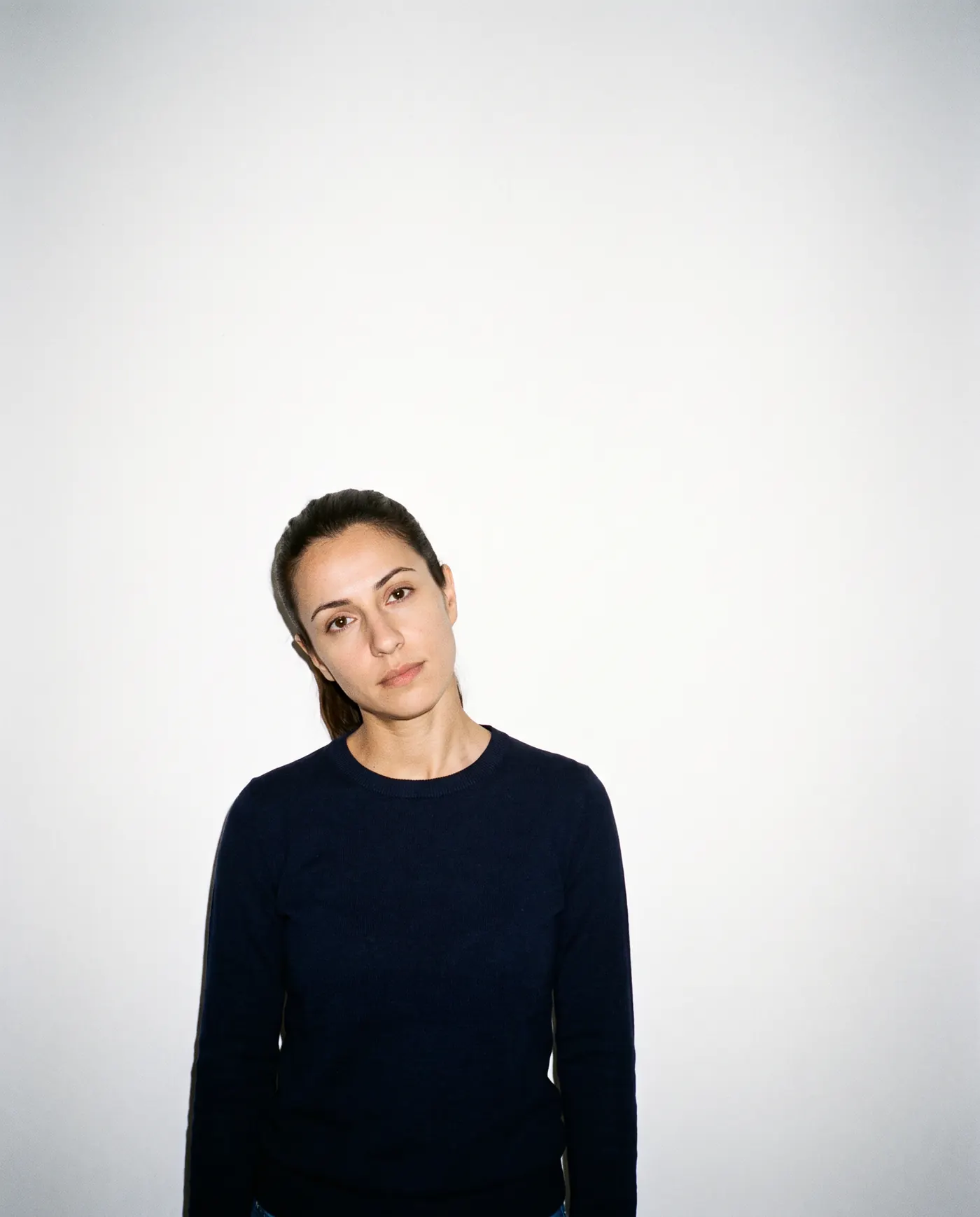 Rejected
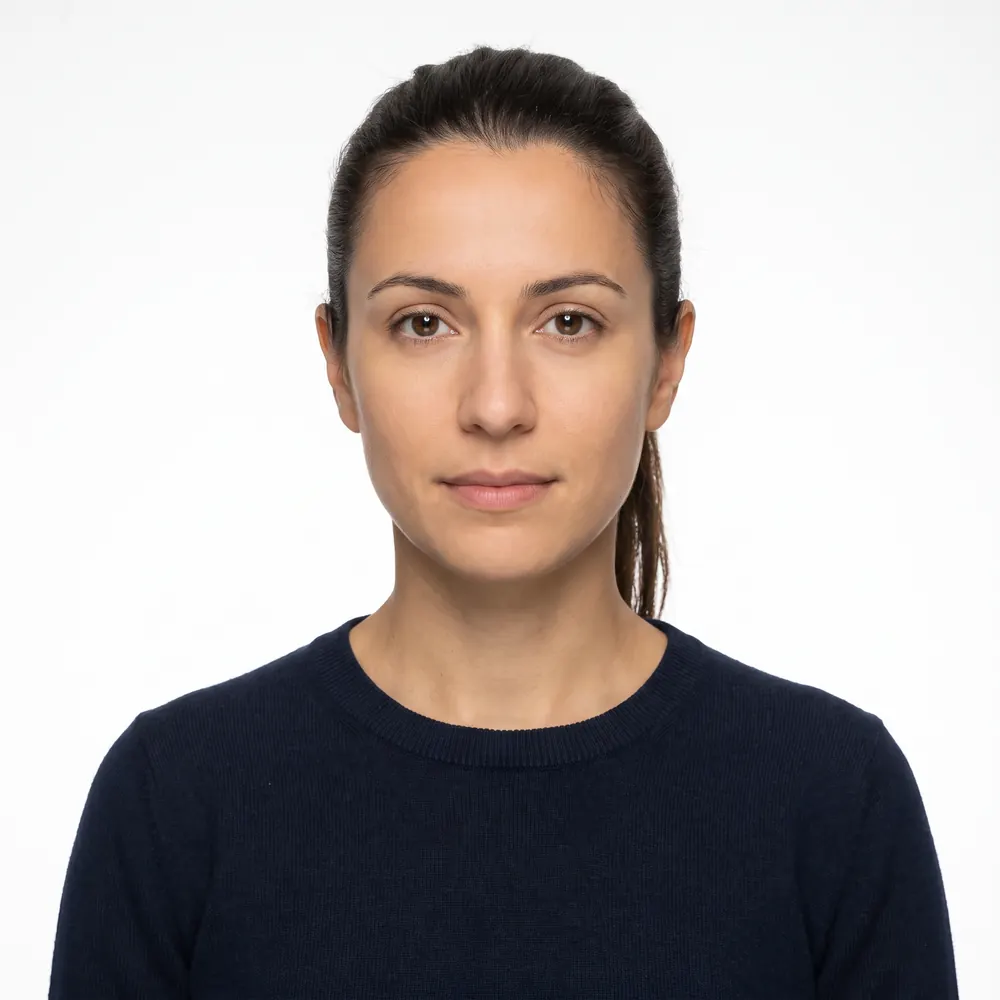 Accepted
One photo per person means one shot per person
The obvious shortcut for a family is to take one good group picture and crop a face out of it for each person. It fails on several rules at once:
- A face cropped out of a group shot is almost never large enough. A 600-pixel head window needs a close original, and group framing puts each face far from the lens.
- Other people end up in the frame: a shoulder, an arm, a hand holding a child still. The instructions' baby tips say no other person should be in the photo.
- Nobody in a group photo is squarely facing the camera with even light at the same time.
A U.S. Embassy DV information page we read puts the conclusion in one line: "Group or family photos will not be accepted; there must be a separate photo for each family member." That page is older than the current instructions, but the current instructions ask for the same thing in different words: individual photographs, same specifications.
For babies and toddlers, the instructions offer two setups that work at home: lay the baby on their back on a plain white or off-white sheet, or cover a car seat with a white sheet and photograph the child in it. Watch for shadows on the face when shooting from above. Our guide to baby passport photos goes further into the lying-down setup; the rules differ slightly between passports and DV entries, so check both.
When both spouses enter
Each spouse may submit one entry of their own if each meets the eligibility requirements, and if either is selected, the other can apply as a derivative. It is the only legitimate way a household gets more than one entry, since the law allows only one entry per person, and more than one entry for a person disqualifies all of that person's entries.
The instructions add the catch: "both entries must include details about all dependents in your family." So if you both enter, both entries need the spouse and every eligible child listed, with photos. Our reading of the instructions is that nothing in them lets one entry lean on the other.
What the instructions do not address is whether the identical image file of a child may appear on both spouses' entries in the same year. They prohibit reusing a prior year's photo and say nothing about the same photo on two entries in the same period. We are not going to fill that gap with a guess. If you want to remove the question entirely, photograph each person twice, a few minutes apart.
What changed with the 2026 rule, and what didn't
The Department of State's final rule, published on March 11, 2026 and effective April 10, 2026, is being implemented with the DV-2027 program. For families, the important points are:
- The passport requirement is for the petitioner. The regulation now asks for the petitioner's passport details and a scan of "the petitioner's biographic and signature page" as a JPEG no larger than 5 MB, subject to limited exemptions. As written, the passport details and scan are the petitioner's; the family members' part of the entry is still their names, birth details, sex and photographs.
- The photo requirement for the family is unchanged in substance. A photograph of the petitioner, spouse and all unmarried children under 21 is still required.
- There is a $1 entry fee. The rule's preamble says all entrants "must pay a $1 fee at the time of submitting their entry," with no waivers.
The rule also states that the Department anticipated "the deferral of the opening of the entry period for the 2027 Diversity Visa program year." That deferral is why nobody honest can tell you the dates. When the Department publishes DV-2027 instructions, read the family and photo sections again; if anything in them changes, we will update this page.
Preparing a family's photos
A household of four or five people means four or five separate shoots, and the time goes into the children, not the files. Do it well before the entry period opens, then keep an eye on the six-month limit.
- A separate photo for you, your spouse and every unmarried child under 21
- Stepchildren and adopted children included, even if they live elsewhere
- Each photo taken within six months of the day you submit
- Each file a 600 x 600 JPEG of 240 kB or less
- Babies photographed alone on a white sheet or in a white-covered car seat
- Faces cropped out of one family or group picture
- Any photo, of anyone, taken from a previous year's entry
- A parent's hand, arm or shoulder visible in a child's photo
- A spouse left off because you are separated without a court order
- Eyeglasses, headphones or retouching on any family member's photo
- 1
Write the family list first
Spouse (unless a U.S. citizen or LPR), then every living, unmarried child under 21 on the day you will enter: natural, adopted, stepchildren. The number of names is the number of photos you need.
- 2
Set up once, shoot everyone
A plain white or off-white wall, even daylight, subject standing a little way off the wall so no shadow falls behind them. Photograph each person alone, camera at eye level, glasses off.
- 3
Do the children when they are calm
For a baby, lay them on a white sheet or in a car seat covered with one, and shoot from above without casting a shadow on the face. No hands in the frame.
- 4
Crop and export each file separately
Square crop, head filling 50-69% of the height, exported as a 600 x 600 JPEG at 240 kB or less. Name each file after the person so nothing gets swapped at upload.
- 5
Check dates before you submit
If the entry period opens more than six months after the oldest photo was taken, retake that photo. Delete the files once the entry period closes so nobody reaches for them next year.
Where our tool fits, honestly
We are an independent photo tool with no connection to the Department of State. We cannot submit an entry, check a selection or tell you who belongs on your entry beyond quoting the instructions, and nobody can improve your odds in a random draw.
What we do is the file work, one person at a time: take a phone photo of each family member, crop it square, check the head sits inside the 50-69% window, and export a 600 x 600 JPEG under 240 kB. We flag what fails before you pay, and you pay only at download: $4.99 per photo, no subscription. We do not retouch faces or swap backgrounds on DV files, because the instructions treat a manipulated photo as grounds for ineligibility. When your family list is written and the wall is white, start with the first photo.
If the entry form rejects one of the files, our guide to DV lottery photo errors maps the validation messages to their causes. And for how the DV entry fits alongside the other US forms that ask for photos, from the DS-160 to USCIS biometrics, see our US visa and immigration photo guide.
After selection: the photos come up again
If you are selected, the family photographs on your entry are not the last ones you will need. Selectees complete the DS-260 online immigrant visa application and attend an interview, and embassies publish their own interview instructions, which can include printed photographs. Our DS-260 photo requirements guide covers that step. The same people who were on your entry are the people the consular officer will expect to see documented.
Frequently asked questions
Does my spouse need a photo on my DV lottery entry?
Yes, unless your spouse is already a U.S. citizen or Lawful Permanent Resident. The DV instructions ask for a photo of your spouse that meets the same technical specifications as yours, and you must list a spouse even if you live apart, unless you are legally separated by a court order.
Which children need a photo on a DV lottery entry?
Every living, unmarried child under 21 on the date you enter: natural children, legally adopted children and stepchildren, even if they do not live with you or will never immigrate. Each child needs an individual photo. Children who are already U.S. citizens or permanent residents do not need one.
Can I use one family photo for everyone on the DV entry?
No. The instructions ask for individual photographs of each child using the same specifications as your own, and a spouse's photo must meet the same specifications too. A U.S. Embassy DV page states plainly that group or family photos will not be accepted.
What happens if I leave a child off my DV entry?
It can cost the whole family the visa. The DV-2026 instructions say that failing to list all eligible children, or listing someone who is not your child, may make you ineligible, in which case your spouse and children are also ineligible as derivative applicants.
Can my spouse and I both enter the DV lottery?
Yes. The instructions allow each spouse to submit one entry if each meets the eligibility requirements. If either is selected, the other can apply as a derivative. Both entries must include details about all dependents in the family, so both need the full set of photos.
Do I need a photo of a child born after I submitted my entry?
No. The instructions say the listing requirement applies to people who were family members when the entry was submitted, not those acquired later. A child born after you entered cannot be on the entry, so there is no photo to submit for them at that stage.
Sources
- U.S. Embassy in Cameroon - Instructions for the 2026 Diversity Immigrant Visa Program (DV-2026), family members, FAQ and Submitting a Digital Photograph
- Federal Register / GovInfo - Visas: Enhancing Vetting and Combatting Fraud in the Diversity Immigrant Visa Program, final rule, 91 FR (March 11, 2026)
- U.S. Embassy in Hungary - Immigrant Visas: Diversity Visa Program (DV-2027 entry period notice)
- U.S. Embassy in Samoa - Beware of Scams: DV-2027 Has Not Started
- U.S. Embassy in Argentina - Diversity Visa Program (separate photo for each family member)
Keep reading
DV Lottery Photo Rules: Don't Get Disqualified
DV lottery photo rules: a 600x600 JPEG under 240 kB, a separate photo per family member, and the reuse rule that makes an entry ineligible.
Read the guideRequirementsUS Visa and Immigration Photos by Form: 2026 Guide
Which US visa and immigration forms need your photo in 2026: DS-160 uploads, DS-260 prints, DV entries, USCIS forms and biometrics, in one sourced table.
Read the guideTroubleshootingDS-160 Photo Upload Error? Fix It in 2 Minutes
Every DS-160 photo upload error explained: what the CEAC check rejects, the exact file specs, and how to make a photo that passes. Pay only at download.
Read the guideRequirementsDS-160 Photo Requirements 2026: Exact Specs
Every DS-160 photo spec with its source: 600x600 to 1200x1200 pixels, 240 kB JPEG, head at 50-69% of image height, no glasses. Checked 16 September 2026.
Read the guideRequirementsPassport Photo Sizes by Country: 2026 Table
Passport photo size by country in mm, inches and pixels, with head heights and backgrounds. Ten authorities, every figure checked on the official page.
Read the guideRequirementsWhy Passport Photos Get Rejected: 10 Real Causes
The ten reasons passport and visa photos really get rejected, the official rule behind each and the fix, plus specs for print, renewal and the DS-160.
Read the guide