Rules
Hijab in a Passport Photo: Religious Covering Rules
Can you wear a hijab, turban or other religious head covering in a passport photo? The exact wording from the US, UK, Canada, Australia, Ireland and India.
By Antoine Duno
Published 12 min read
Specs verified on September 16, 2026 against the issuing authority
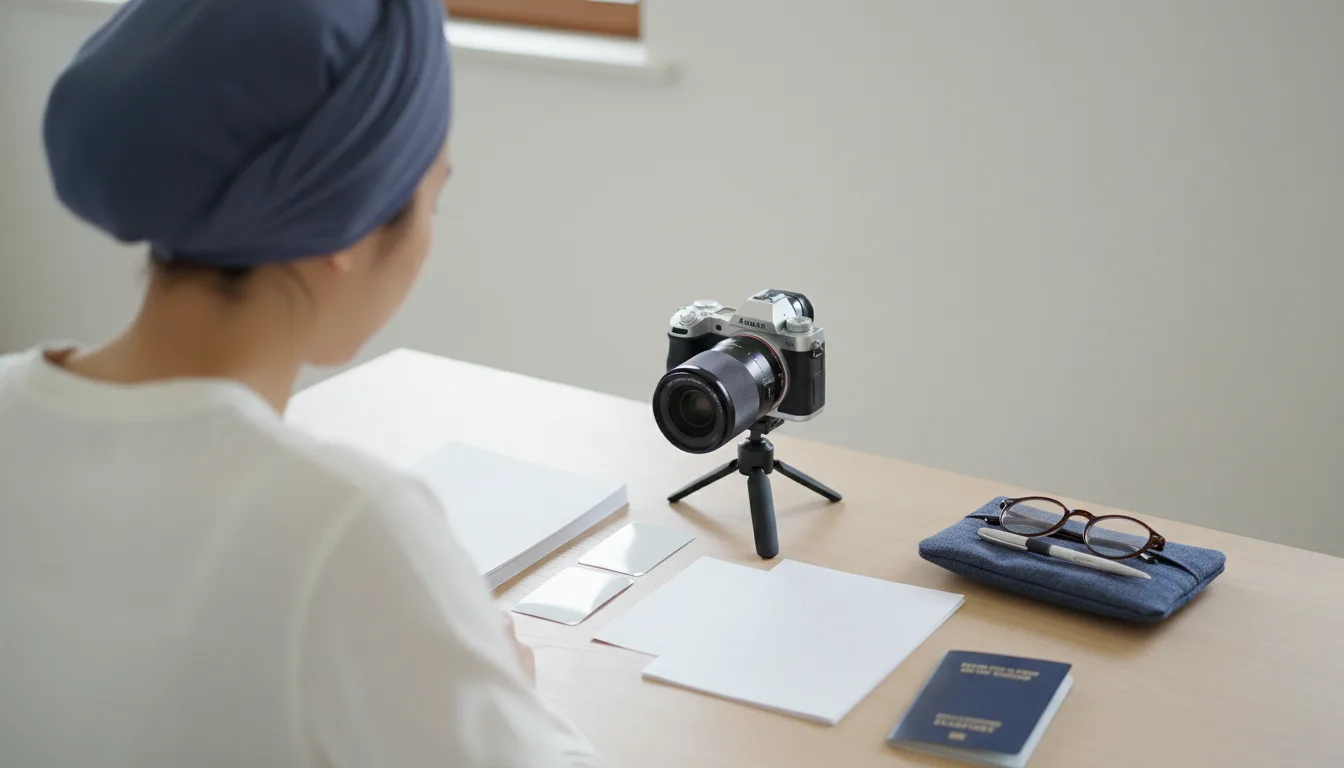
Wearing a hijab, turban, kippah or other religious head covering in a passport photo is allowed by every authority in this guide. None of them asks you to uncover your head. What they all ask is that your face stays fully visible, and the details that decide a rejection are small: a pattern on the fabric, a shadow along the jaw, a white scarf against a white wall, or a missing signed statement.
We quote each authority rather than paraphrase it, because the wording is where applicants and examiners disagree. Every page was read on September 16, 2026, and the office that issues your document makes the final decision.
- US passport
- Allowed; one color, no patterns; signed statement (in person or mail)
- US visa (DS-160, DV)
- Allowed if worn daily for a religious purpose; no shadows
- UK passport
- Allowed for religious or medical reasons; face uncovered
- Ireland passport
- Allowed if full facial features clearly visible
- Canada passport
- Allowed if worn daily; full face visible, no shadows
- Canada visitor visa
- Allowed; full facial features not obscured
- Australia passport
- Allowed; plain, no patterns; chin to forehead and edges visible
- India passport
- Religious only; chin to forehead and both edges visible
- Germany (UK missions, Schengen)
- Religious coverings accepted; face fully visible, no shadows
What every authority is protecting
Read side by side, the rules all protect the same zone. The Australian Passport Office and India's Passport Seva booklet use almost identical words for it: the face from the bottom of the chin to the top of the forehead, and both edges of the face. The US, UK, Canada and Ireland say "full face" or "full facial features" and mean the same thing.
The hair, the ears and the top of the head are not in that zone. That is why a covering over them is acceptable, while the same covering pulled forward over the forehead or tucked under the jawline is not.
It also explains a detail people miss. ICAO Doc 9303, the international standard behind passport design, doesn't set head covering rules itself. Part 3 points portrait capture to a separate ISO standard, and each country writes its own wording. So there is no single international rule to rely on. Follow the page of the authority issuing your document.
United States: passports
The State Department's passport photos page (last updated March 24, 2026) starts from a default of no head covering and then sets out the exception:
Take off your hat or head covering. If you wear one for religious purposes, submit a signed statement that says it is religious attire worn daily in public.
If you wear one, four conditions apply, in the page's words: "Your full face must be visible", "There should be no shadows or parts of your face blocked", "It should be one color", and "The material should not have patterns or small holes".
The statement. The photo examples on the same page say: "If you are applying in person or by mail, please provide a signed statement about why you are wearing a hat or head covering." The page doesn't give a template. Its own description of the statement is the safest wording to follow: signed, and saying the covering is religious attire worn daily in public.
Online renewal. The Uploading a Digital Photo page asks you to remove anything covering your face "unless for documented religious or medical reasons" and doesn't mention a statement for online applications. The one-color, no-pattern and no-small-holes conditions still apply.
Two failures the examples show. Among the unacceptable examples: "Your head covering blocks part of your face, and there are shadows on your face", and "Your scarf covers a portion of your face." Both are about how the covering sits, not whether you wear one.
The rest of the US rules are in our US passport photo requirements guide.
United States: visas and the DV lottery
Visa photos use different wording and no statement. The State Department's visa photo page says: "Do not wear a hat or head covering that obscures the hair or hairline, unless worn daily for a religious purpose. Your full face must be visible, and the head covering must not cast any shadows on your face."
Its photo FAQ repeats the rule and adds a clothing point that matters for some religious dress: uniforms and camouflage "should not be worn in photos except in the case of religious attire that is worn daily."
Note the word daily in both places. The visa rules describe a covering you wear every day, not one put on for the photo.
United Kingdom: religious or medical, and never the face
GOV.UK's rules for printed and digital photos share one line: you must "not have a head covering (unless it's for religious or medical reasons)", followed by "not have anything covering your face" and "not have any shadows on your face or behind you".
HM Passport Office's caseworker guidance, Photo standards (version 51.0, published for staff on January 19, 2026), shows how examiners apply that line. Three passages are worth knowing before you take the photo.
What examiners accept. "We may accept head coverings worn for religious reasons, as long as they do not cover the face."
What examiners check in the photo. The guidance tells them not to accept headwear that "casts a shadow on or around the face if the shadows hide the customer's face", "hides parts of the customer's face", "distorts or alters the customer's face (for example, very tight scarves)", or "causes contrast problems between the customer's head and the background (for example, head coverings that are white or light in colour)".
What happens if they're unsure. If an examiner has doubts that a covering is worn for religious or medical reasons, they must ask you to write to HM Passport Office stating that it is worn for those reasons and is "a normal part of their daily attire". Coverings worn for cultural reasons are refused: the guidance's examples are "a Fez, Keffiyeh, headdress or a cowboy hat".
If you apply online and the photo check flags your head covering, the same guidance says you can still use the photo "if they cannot meet the rules because of a religious or medical reason", and you'll be asked to explain why. Our guide to UK passport photos rejected online covers that override, and UK passport photo requirements has the full UK spec.
Ireland
The Department of Foreign Affairs' photo guidelines say: "You can wear a head covering for religious or medical reasons. Your full facial features must be visible. You cannot wear head accessories for any other reason." Its FAQ answers the question directly: a religious head covering "is permitted to wear it in your passport photo only if full facial features are clearly visible."
Canada: passports and visitor visas
Passport. IRCC's photos for Canadian passports page accepts "hats and head coverings worn daily for religious beliefs or medical reasons", on two conditions: "Your full face must be clearly visible" and "The head covering must not create shadows on your face." A covering "not worn daily for religious beliefs or medical reasons" is refused. The Canadian passport photo is taken by a commercial studio, so tell the photographer before they set up the lights; see Canada passport photo requirements.
Visitor visa. IRCC's temporary resident visa photo specifications say: "If you must wear a head covering for religious reasons, make sure your full facial features are not obscured." The same page answers the measuring question that a covering raises. Face height is chin to crown, and "crown means the top of the head or (if obscured by hair or a head covering) where the top of the head or skull would be if it could be seen." So the fabric piled on top doesn't count toward your head size.
Australia: plain means no pattern at all
The Australian Passport Office is the most specific about fabric. Its photo guidelines (read on an archived copy of November 14, 2025, because the live page did not respond) say: "Religious head coverings must be plain, without patterns (even small patterns). You must wear them in a way that shows your entire face from the bottom of your chin to the top of your forehead. The edges of your face on either side must also be visible."
"Even small patterns" rules out a subtle print or a woven texture that reads as a pattern on camera. A patterned covering appears in its unacceptable examples. More in our Australia passport photo requirements guide.
India
Passport Seva's instruction booklet (version 3.0): "Head coverings are not permitted except for religious reasons, but the facial features from bottom of chin to top of forehead and both edges of the face must be clearly visible." The India passport photo requirements guide explains when you need a printed photo at all.
Schengen visas
There's no single Schengen photo page, and consulates word this differently. The German missions in the UK: "Do not wear a hat or head covering that obscures the hair or hairline (religious face coverings are acceptable). Your face must be fully visible, and the head covering must not cast any shadows on your face." Despite the phrase "face coverings" in the parenthesis, the next sentence requires the face to be fully visible, so read it as religious head coverings. Other consulates are compared in Schengen visa photo requirements.
Face veils
No authority in this guide accepts a photo with the face covered. The US page says: "Take off any face covering or medical mask. Your full face must be visible." GOV.UK says nothing may cover your face, and HM Passport Office accepts religious coverings "as long as they do not cover the face". If you wear a niqab or another face veil, the photo is taken with the face uncovered and the head covering in place. How and where that photo is taken is worth asking the issuing office or your photographer about in advance.
Side by side
| Authority | Religious covering | Pattern rule | Statement or letter | Face zone |
|---|---|---|---|---|
| US passport | Allowed | One color, no patterns or small holes | Signed statement, in person or mail | Full face, no shadows |
| US visa / DV | Allowed if worn daily | Not stated | None | Full face, no shadows |
| UK passport | Allowed (also medical) | Not stated; light colours flagged for contrast | Letter if the examiner is unsure | Face not covered, no shadows |
| Ireland | Allowed (also medical) | Not stated | None stated | Full facial features |
| Canada passport | Allowed if worn daily | Not stated | None stated for religious | Full face, no shadows |
| Canada visitor visa | Allowed | Not stated | None stated | Full facial features |
| Australia passport | Allowed if usually worn | Plain, no patterns, even small | None stated | Chin to forehead, both edges |
| India passport | Religious only | Not stated | None stated | Chin to forehead, both edges |
The pattern across countries: the permission is broad, and the conditions are about the photograph. For how head coverings compare with other causes of rejection, see why passport photos get rejected.
Taking the photo with a head covering
- 1
Choose a plain, single-colour covering
No print, no woven pattern, no lace or small holes. If the background has to be white or off-white, pick a colour that stands clearly apart from it rather than white or cream.
- 2
Pin it back from the face
The fabric should sit behind the hairline or at the top of the forehead and outside the edges of the face, and below the chin rather than across the jawline. Avoid wrapping it so tightly that it pulls on the face; the UK guidance names very tight scarves.
- 3
Light the face from the front
A covering that extends forward over the forehead catches overhead light and throws a shadow onto the eyes. Face a window or a soft light at head height, and turn off overhead lights.
- 4
Stand well clear of the wall
Several feet away, so neither your head nor the fabric casts a shadow on the background.
- 5
Zoom in before you accept the shot
Check the forehead line, both cheek edges and under the chin at full size. Loose fabric that drifted forward is the most common way a covering ends up over the face.
- 6
Prepare the paperwork
US passport in person or by mail: a signed statement that the covering is religious attire worn daily in public. UK: be ready to explain in writing if asked. Check your own office's page for anything else.
What our tool can and can't judge
Our photo checker doesn't treat a head covering as a fault. It estimates the top of the head from your face rather than from the outline of your hair or fabric, and when the result is close to the edge of the allowed range it says so rather than passing it. It checks head tilt, whether the background is plain and even, sharpness and exposure, which catches heavy shadow and underexposure.
It doesn't judge the covering itself. It can't tell whether fabric is patterned, whether it sits over the forehead or jawline, or whether a thin shadow crosses the face, and it can't write your statement. Look at those yourself on the full-size image, using the list below.
The head covering checklist
- Worn for religious reasons, as part of what you wear daily
- Plain, one colour, no pattern or small holes
- Chin to top of forehead and both edges of the face visible
- Even light on the face, no shadow from the fabric
- Colour that contrasts with the background
- Signed statement included for a US passport in person or by mail
- Fabric across the forehead, cheeks or jawline
- A white or cream covering that merges into a white background
- A printed, lace or textured scarf
- Anything covering the face itself
Glasses follow the same "eyes and face fully visible" logic and have their own country rules: see glasses in passport photos. Hair falling across the face is covered in passport photo hair rules.
Frequently asked questions
Can I wear a hijab in my passport photo?
Yes, in every country covered here, if you wear it for religious reasons and your whole face stays visible. The US passport rules add that the covering should be one color with no patterns or small holes, and ask for a signed statement with paper applications. Australia also asks for a plain covering without even small patterns.
What statement do I need for a religious head covering on a US passport photo?
A signed statement that says the head covering is religious attire worn daily in public. The State Department asks for it when you apply in person or by mail. Its online renewal photo page does not mention the statement, but it does repeat that the covering must be one color without patterns or small holes.
How much of my face has to show with a head covering?
All of it. Australia and India spell out the boundary: from the bottom of the chin to the top of the forehead, with both edges of the face visible. The US, UK, Canada and Ireland say your full face or full facial features must be visible, and several add that the covering must not cast shadows on the face.
Can I wear a niqab or face veil in a passport photo?
No authority in this guide accepts a photo with the face covered. The US says to take off any face covering, the UK says nothing may cover your face, and HM Passport Office accepts religious head coverings only as long as they do not cover the face. A head covering that leaves the face fully visible is accepted.
Can I wear a white hijab against a white background?
It is risky. HM Passport Office's caseworker guidance lists head coverings that are white or light in colour among those that cause contrast problems between the head and the background. For a white or off-white background, like the US requires, a plain, darker single-color covering keeps the outline of your head clear.
Can I wear a hat or head covering for cultural reasons?
Not in a UK passport photo. HM Passport Office's guidance says it must not accept a head covering worn for cultural reasons, giving a fez, keffiyeh, headdress or cowboy hat as examples. The other authorities here allow coverings only for religious or medical reasons, so a cultural or fashion reason is not an exception.
Sources
- U.S. Department of State - Passport Photos (last updated March 24, 2026; read on the adoption.state.gov mirror)
- U.S. Department of State - Uploading a Digital Photo (online renewal; read on the adoption.state.gov mirror)
- U.S. Department of State - Visa photo requirements (read on the adoption.state.gov mirror)
- U.S. Department of State - Visa photo frequently asked questions (read on the adoption.state.gov mirror)
- GOV.UK - Get a passport photo: printed photos
- GOV.UK - Get a passport photo: digital photos
- HM Passport Office - Photo standards: caseworker guidance, version 51.0
- Department of Foreign Affairs (Ireland) - Passport photo guidelines
- IRCC - Photos for Canadian passports
- IRCC - Temporary resident visa application photograph specifications (modified July 24, 2023)
- Australian Passport Office - Photo guidelines (archived copy of November 14, 2025; the live page did not respond)
- Passport Seva - Instructions for filling the passport application form (V3.0)
- German Missions in the United Kingdom - Visa FAQ: photo requirements
- ICAO - Doc 9303, Machine Readable Travel Documents, Part 3 (eighth edition, 2021)
Keep reading
 Requirements
Why Passport Photos Get Rejected: 10 Real Causes
The ten reasons passport and visa photos really get rejected, the official rule behind each and the fix, plus specs for print, renewal and the DS-160.
Read the guide Rules
Glasses in Passport Photos: Rules in 10 Countries
Can you wear glasses in a passport photo? Official rules for the US, UK, Ireland, Canada, Australia, NZ, India, France, Germany and Spain.
Read the guide Requirements
US Passport Photo Requirements (2026): Complete Checklist
Every US passport photo rule in one checklist: 2x2 inch size, head height, white background, expression, glasses, head coverings and online renewal.
Read the guide Requirements
AI-Edited Passport Photos Get Rejected in 2026
The State Department says it checks photos for AI tools and will not accept edited or filtered images. What counts as an edit, and what is still allowed.
Read the guide Rules
Can You Smile in a Passport Photo? Rules by Country
Can you smile in a passport photo? Official answers for the US, UK, Canada and Schengen visas, plus glasses, makeup, hair, head coverings and babies.
Read the guide Troubleshooting
US Passport Photo Rejection Letter: What to Send Back
Got a letter saying your passport photo can't be accepted? The 90-day deadline, where to mail the new photo, and how to make sure the second one passes.
Read the guide