Rules
Glasses in Passport Photos: Rules in 10 Countries
Can you wear glasses in a passport photo? Official rules for the US, UK, Ireland, Canada, Australia, NZ, India, France, Germany and Spain.
By Antoine Duno
Published 11 min read
Specs verified on September 16, 2026 against the issuing authority
Whether you can keep your glasses on for a passport photo depends on which country issues the document, and sometimes on which document from the same country. The United States says no. Canada says yes for a passport. India says yes for a passport and no for an e-Visa. And almost everyone who says yes adds conditions that are easy to fail on a phone photo: no glare, no tint, no frame across the eye.
We read each authority's own page for this guide on September 16, 2026. Where a government site refused automated readers, we used an official mirror or an archived copy of the same page, and say so in the sources. The authority that issues your document makes the final decision on your photo.
- US passport
- Off; medical exception with doctor's note
- US visa (DS-160, DS-260)
- Off since Nov 1, 2016; rare medical exception
- US DV lottery entry
- Off
- UK passport
- Only if you have to; no tint, glare or frames over eyes
- Ireland passport
- Allowed; frames clear of eyes, no glare
- Canada passport
- Allowed; eyes clearly visible, no glare, no tint
- Canada visitor visa
- Non-tinted prescription glasses allowed
- Australia passport
- Off unless medical; eyesight alone not a reason
- New Zealand passport
- Allowed if not tinted or thick-framed
- India passport
- Allowed; no coloured or dark glasses
- India e-Visa
- Without spectacles
- France passport and ID card
- Optional; thin frames, no tint or reflection
- Germany (UK missions), Spain (LA)
- Frames clear of eyes; no dark or reflective lenses
Why so many authorities have gone strict on glasses
Every rule in the table protects the same thing: a clear view of the eyes. The US visa FAQ names the three ways glasses get in the way, and the other authorities use versions of the same list. Frames can cover part of the eye. Glare on the lens can hide it. And there can be "shadows or refraction from the eyeglasses" that obscure it.
The countries that allow glasses don't relax any of those conditions. They leave it to your photo to show there is no problem. The countries that ban glasses skip the question and ask you to take them off.
United States: off, for every document
Passport. The State Department's passport photo page is short on this: "Take off any eyeglasses, sunglasses, or tinted glasses. Do not rest them on your head for the photo." Its unacceptable examples include a photo with glasses pushed up on the head. The exception reads: "If you cannot remove your glasses for medical reasons, please include a signed note from your doctor with your application." The rest of the US passport rules are in our US passport photo requirements guide.
Visas. The visa photo FAQ dates the change: "Effective November 1, 2016, eyeglasses are no longer allowed in new visa photos, except in rare circumstances when eyeglasses cannot be removed for medical reasons." It gives ocular surgery as the example and requires "a medical statement signed by a medical professional/health practitioner." Even with the statement, the frames must not cover the eyes and there must be no glare, shadow or refraction obscuring them. This applies to the DS-160 upload and to the prints you bring to an immigrant visa interview.
DV lottery. The Diversity Visa instructions, as published on the U.S. Embassy in Cameroon's site, say only: "Do not wear eyeglasses." They offer no medical exception. They do allow a hearing device you normally wear, which trips people up in the other direction; more on devices in our guide to hearing aids and medical devices in passport photos.
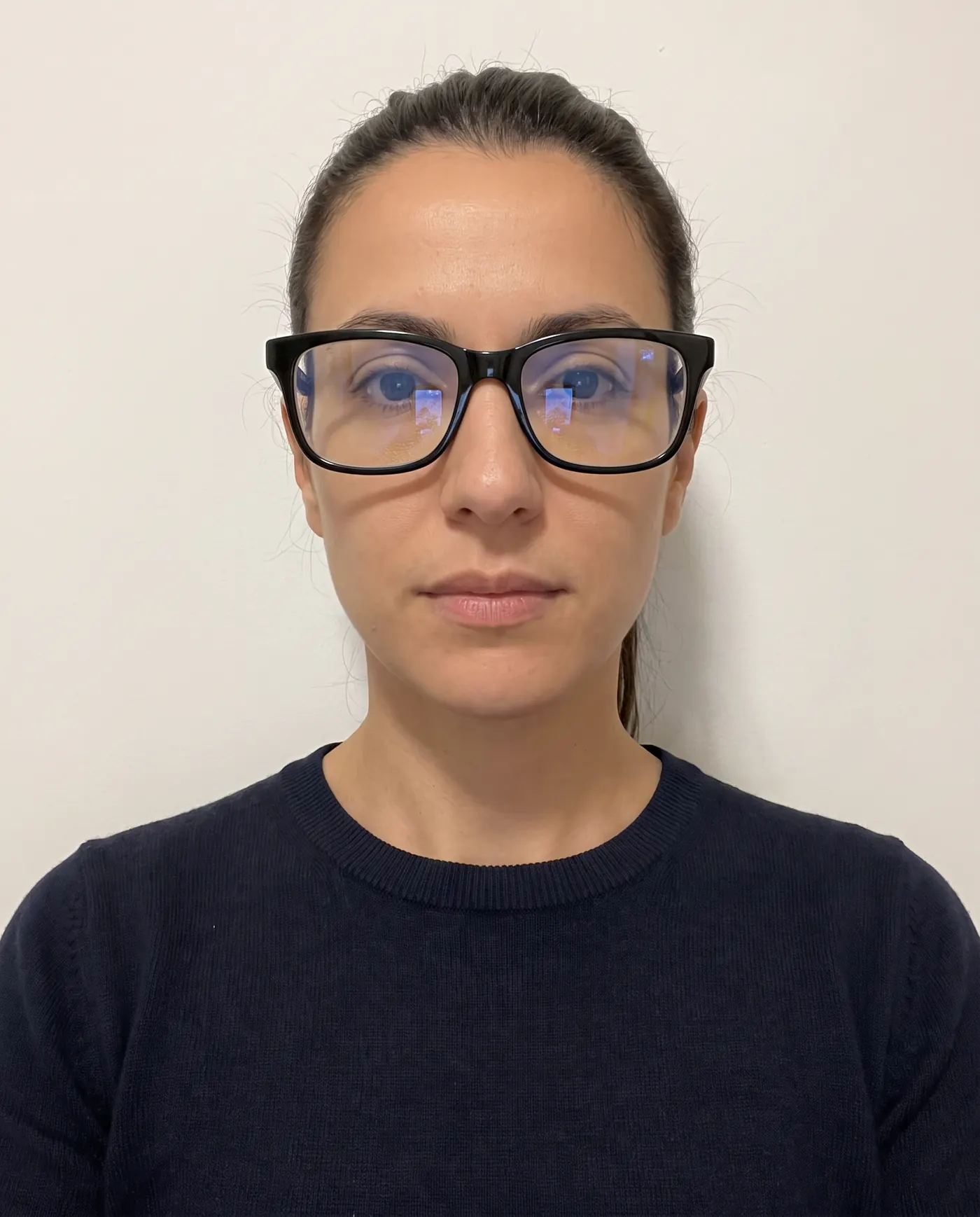 Rejected
 Accepted
United Kingdom: only if you have to
GOV.UK uses the same sentence on its digital and printed photo pages: "Do not wear glasses in your photo unless you have to do so. If you must wear glasses, they cannot be sunglasses or tinted glasses, and you must make sure your eyes are not covered by the frames or any glare, reflection or shadow."
"Unless you have to" is not defined, and GOV.UK doesn't ask for a medical note. The practical reading: if you can take them off for a few seconds, take them off. If you keep them on, every part of the second sentence has to hold, and a reflection over one eye is enough to break it. Our UK passport photo requirements guide has the rest of the UK rules.
Ireland: allowed, with the eyes clear
Ireland is one of the more permissive authorities. The Department of Foreign Affairs' photo guidelines say: "You can wear glasses. The frame must not cover any part of your eyes. There must be no glare on the lenses. Dark glasses are not permitted." Its FAQ repeats the point with one extra word: "Transparent glasses may be worn so long as they do not cause glare or shadows or the frames do not cover any part of the eye."
Canada: allowed for passports and visitor visas
Passport. IRCC's page on photos for Canadian passports (modified February 11, 2026) accepts "glasses, if your eyes are clearly visible and there is no glare on the lenses." It refuses "sunglasses or tinted eye glasses," and adds a line other countries leave implicit: "This includes prescription lenses, even when your eyes are clearly visible." Canada also requires a commercial photographer for passport photos, so a studio will be taking the shot. Ask them to check the lenses before printing. The Canada passport photo requirements guide covers the stamp and the rest.
Visitor visa. IRCC's temporary resident visa photo specifications say: "You may wear non-tinted prescription glasses as long as your eyes are clearly visible. Make sure that the frame does not cover any part of your eyes. Sunglasses are not acceptable." Note the word prescription: fashion frames with plain lenses aren't what the rule describes.
Australia: off, and eyesight is not the exception
The Australian Passport Office is the strictest of the countries that offer an exception. Its photo guidelines say: "You must not wear glasses in a passport photo unless you can't remove them for medical reasons. Vision impairment alone is not an acceptable reason to wear glasses in your photo." If a medical reason applies, the frames must not obscure your eyes and there must be no reflection from the lenses. For any rule you cannot meet because of a medical condition, the page asks you to provide a medical certificate or complete a B-11 form explaining why.
That sentence about vision impairment answers the question most people with strong prescriptions ask. Not being able to see without glasses is not the medical reason. The Australia passport photo requirements guide covers the print rules, which are a separate problem.
New Zealand: allowed if not tinted or thick-framed
New Zealand's passport photo guide says you "can wear prescription glasses in your photo if they are not tinted or thick-framed," with no sunglasses, and asks for "a clear gap between your eyes and the frames" and "no glare or reflection on the lenses." Immigration New Zealand's visa and NZeTA photo page has matching rules (clear, not tinted, no heavy frames, no glare) and adds some practical advice: "If you are having issues with glasses, it may be best to remove them for your photo."
The same page lists "digitally removing objects from the photo, especially around the image of your face, for example, glasses" as an edit that isn't allowed. Retaking without glasses is fine. Erasing them from a photo is not.
India: the passport and the e-Visa disagree
Passport. Passport Seva's instruction booklet rules out photographs "with eyes hidden under coloured or dark glasses" and gives advice we haven't seen from any other authority: "Glares on eyeglasses should be avoided with a slight upward or downward tilt of the head." So clear glasses are allowed on the passport photo, provided you deal with the glare. The India passport photo requirements guide explains when you need a printed photo at all, since most Passport Seva Kendra applicants don't.
e-Visa. The Indian e-Visa portal's upload specification asks for a photo that shows "full face, front view, eyes open and without spectacles." Travellers who already hold an Indian passport photo with glasses, or who are applying for both a passport and a visa for family members, are the ones who get caught by this. More in our India e-Visa photo guide.
France: optional, with thin frames and clear lenses
Service-Public, the French government's information site, lists the norms for passport and identity card photos (checked by its editors on March 11, 2026). On glasses it says you are not obliged to wear them in the photo. If you do, the frame must not be thick or hide the eyes, and the lenses must be neither tinted nor coloured, with no reflection. The same page warns that a photo that doesn't meet the norms is rejected and the document isn't issued. France also requires the photo to come from an approved professional or an approved booth, and bans a white background, so a US-style photo won't carry over.
Schengen visas: consulate by consulate
There is no single Schengen glasses rule, because consulates publish their own checklists. Two examples:
- German missions in the UK: "Glasses/ spectacles are permitted in as far as the frames do not cover any part of the eyes."
- Consulate General of Spain in Los Angeles: the photo must be "without dark or reflective glasses."
Many visa centres also capture your face at the appointment, so check whether yours wants a print at all. Our Schengen visa photo requirements guide compares other consulates.
Side by side: what each authority checks
| Authority | Glasses allowed? | Tint | Glare | Frames over eyes | Paperwork for exception |
|---|---|---|---|---|---|
| US passport | No | Not allowed | n/a | n/a | Signed doctor's note |
| US visa | No | Not allowed | Not allowed if exempt | Not allowed if exempt | Signed medical statement |
| DV lottery | No | Not allowed | n/a | n/a | None offered |
| UK passport | If you have to | Not allowed | Not allowed | Not allowed | None stated |
| Ireland | Yes | Dark glasses not allowed | Not allowed | Not allowed | None needed |
| Canada passport | Yes | Not allowed, incl. prescription | Not allowed | Eyes must be clearly visible | None needed |
| Canada visitor visa | Prescription, non-tinted | Not allowed | Not stated | Not allowed | None needed |
| Australia passport | Medical reason only | n/a | Not allowed if exempt | Not allowed if exempt | Medical certificate or B-11 form |
| New Zealand passport | Yes, not thick-framed | Not allowed | Not allowed | Clear gap required | None needed |
| India passport | Yes | Coloured or dark not allowed | Avoid with head tilt | Not stated | None needed |
| India e-Visa | No | n/a | n/a | n/a | None offered |
| France passport and ID | Optional | Not allowed | Not allowed | Thin frames, eyes not hidden | None needed |
The pattern is simple to act on. Where glasses are banned, the exception is narrow and needs a document. Where they are allowed, the burden moves to the photo, and glare is the condition people fail. For how glasses compare with the other common causes, see why passport photos get rejected.
If you keep your glasses on: how to beat glare
Only do this where the table says glasses are allowed, and only if taking them off isn't an option.
- 1
Turn off the flash and overhead lights
Glare is a light source reflected in the lens. A flash in front of you or a ceiling light above you will almost always show up. Use daylight from a window instead.
- 2
Move the light off to one side
A window beside the camera, rather than directly behind it, lights your face while sending its reflection away from the lens. Check the far side of your face for shadows.
- 3
Tilt the glasses, not your whole head
Lifting the arms of the frames slightly off your ears angles the lenses down and moves the reflection out of the frame. India's booklet suggests a slight tilt of the head, but a tilted head fails other countries' rules.
- 4
Push the frames up so the rim clears your eyes
Canada, Ireland, New Zealand, France and the German missions all refuse frames that cover the eyes. Heavy or low-sitting frames are the usual problem.
- 5
Zoom in on the eyes before you accept the shot
Look at each lens on the full-size image. A white patch or a shadow line across either eye means retake. It is much harder to see on a phone thumbnail.
If any step doesn't work, take the glasses off. Don't try to remove a reflection or the glasses in an editor. The US, New Zealand and most other authorities treat that as altering the photo, which is a separate reason for rejection covered in AI-edited passport photos.
What our tool can and can't tell you about glasses
Honest version: we don't reliably detect glasses. When you pick a document where glasses matter, our checker marks the glasses check as unverified and shows you the rule for that document instead of guessing. The checks we do run are head height, eye line, head tilt, background evenness, sharpness and exposure.
So the workflow is: take the photo with glasses off wherever the table says off, run it through the checker for everything else, and look at your own eyes on the full-size image before you pay. We crop and resize the photo to the size your document needs. We don't retouch faces or remove objects, including glasses.
The glasses checklist
- Glasses off for US passports, US visas, the DV lottery, Australian passports and Indian e-Visas
- Medical exception paperwork included where the US or Australia requires it
- Where glasses are allowed: clear lenses, eyes fully visible
- No white patch of reflected light on either lens, checked at full size
- Frame rims sit above or below the eyes, never across them
- Sunglasses or tinted lenses, including tinted prescription lenses
- Glasses pushed up onto the head or hair
- Thick or heavy frames that shadow the eyes
- Glasses or glare removed afterwards with editing software
Glasses aren't the only thing the eye rules affect. Expression, hair over the eyes and head coverings all fall under the same "face fully visible" wording; see can you smile in a passport photo and hijab and religious head coverings in passport photos. If you are preparing photos for several countries at once, check the sizes too: our passport photo sizes by country table has the formats side by side.
Frequently asked questions
Can you wear glasses in a US passport photo?
No. The State Department says to take off eyeglasses, sunglasses and tinted glasses, and not to rest them on your head. If you cannot remove them for medical reasons, include a signed note from your doctor with the application. US visa photos have banned eyeglasses since November 1, 2016, with a similar medical exception.
Which countries allow glasses in passport photos?
Of the authorities in this guide, Canada, Ireland, New Zealand and France allow clear glasses in a passport photo, and India's passport booklet only bans coloured or dark glasses. All of them require eyes clearly visible, no glare and no tinted lenses. The UK allows them only if you have to wear them.
Can I wear glasses in a UK passport photo?
Only if you have to. GOV.UK says not to wear glasses unless you must. If you do, they cannot be sunglasses or tinted, and your eyes must not be covered by the frames or by any glare, reflection or shadow. The same wording applies to digital and printed photos.
Is poor eyesight a medical reason to keep glasses on?
Not in Australia, which says so directly: vision impairment alone is not an acceptable reason to wear glasses in your photo. The US visa rules give recent eye surgery as their example of a real medical case. Needing glasses to see is not, on its own, the exception.
Are prescription tinted or light-reactive lenses allowed?
Tinted lenses are refused everywhere in this guide, prescription or not. Canada's passport page says the tinted-glasses ban includes prescription lenses even when your eyes are clearly visible. If your lenses darken in daylight, take the photo with them off, or indoors once they have fully cleared.
Do I need glasses off for an Indian e-Visa photo?
Yes. The Indian e-Visa page asks for a photo showing full face, front view, eyes open and without spectacles. That is stricter than the Indian passport booklet, which only rules out eyes hidden under coloured or dark glasses. Do not reuse one photo for both without checking.
Sources
- U.S. Department of State - Passport Photos (last updated March 24, 2026; read on the adoption.state.gov mirror)
- U.S. Department of State - Visa Photo Frequently Asked Questions (eyeglasses)
- U.S. Mission Poland - Visa Photo Requirements
- U.S. Embassy in Cameroon - Instructions for the DV-2026 Diversity Immigrant Visa Program
- GOV.UK - Get a passport photo: digital photos
- GOV.UK - Get a passport photo: printed photos
- Department of Foreign Affairs (Ireland) - Passport photo guidelines
- IRCC - Photos for Canadian passports (modified February 11, 2026)
- IRCC - Temporary resident visa application photograph specifications
- Australian Passport Office - Photo requirements (archived copy of November 14, 2025; the live page did not respond)
- New Zealand Passports - How to take a passport photo (archived copy of September 2, 2026)
- Immigration New Zealand - Acceptable photos for a visa or NZeTA
- Passport Seva - Instructions for filling the passport application form (V3.0)
- Government of India - e-Visa application page (document and photo specifications)
- Service-Public.fr - Photo d'identité: normes (verified March 11, 2026)
- German Missions in the United Kingdom - Visa FAQ: photo requirements
- Consulate General of Spain in Los Angeles - Schengen visas
Keep reading
 Requirements
Why Passport Photos Get Rejected: 10 Real Causes
The ten reasons passport and visa photos really get rejected, the official rule behind each and the fix, plus specs for print, renewal and the DS-160.
Read the guide Rules
Can You Smile in a Passport Photo? Rules by Country
Can you smile in a passport photo? Official answers for the US, UK, Canada and Schengen visas, plus glasses, makeup, hair, head coverings and babies.
Read the guide Requirements
US Passport Photo Requirements (2026): Complete Checklist
Every US passport photo rule in one checklist: 2x2 inch size, head height, white background, expression, glasses, head coverings and online renewal.
Read the guide Requirements
AI-Edited Passport Photos Get Rejected in 2026
The State Department says it checks photos for AI tools and will not accept edited or filtered images. What counts as an edit, and what is still allowed.
Read the guide Requirements
DS-260 Photo Requirements 2026: Two Prints, No Upload
DS-260 immigrant visa photos: two identical 2x2 inch color prints at the interview, head 1 to 1 3/8 in, no glasses. How it differs from DS-160 and USCIS.
Read the guide Requirements
India e-Visa Photo Upload: Size, Format and Fixes
The photo India's e-Visa portal accepts: square JPEG, 10 KB to 1 MB, no glasses, plain white or light background, plus fixes for the upload errors.
Read the guide